7 Month Old Baby Fever No Other Symptoms
During the solar day, information technology is normal for the temperature to fluctuate in children. Information technology is usually lower in the morning and rises equally the day progresses. It can likewise vary according to the child's activeness.
More than 60% of parents with children anile between half-dozen months and five years, report a case of fever in their children.
Though loftier temperature tin can be a cause for concern for most parents, information technology is usually cocky-resolving and disappears in a few days.
If the rise in temperature persists for 24 hours, then the kid is diagnosed with fever, indicating some underlying illness. The illness may often be harmless and triggered past balmy viral infections similar cold and cough.
The hypothalamus resets the body to a college temperature in response to an infection, affliction, or some other cause, to fight off the germs that cause infections.
What are the Causes of Baby Fever?
Fever is ordinarily a symptom of an underlying illness and non an illness on its own. Few factors that trigger fever in infants are:
1. Infections: These are the well-nigh common cause of fever in children. Fever helps the body to fight infections, past stimulating natural defence mechanisms.
Viral - Nearly infections are viral, which are responsible for colds and upper respiratory infections. Common infectious diseases of childhood, such as chickenpox and measles tin can also cause fever. Viral infections do not necessarily need treatment except to alleviate some symptoms and they resolve on their ain subsequently proper care in a few days.
Bacterial- Bacterial infections including certain ear and throat infections, urinary tract infections, pneumonia, claret infections and meningitis are not self-resolving and demand treatment with antibiotics.
Inflammation of the meninges, the membranes that encompass the brain and spinal cord is called meningitis. Most cases are caused by bacteria or viruses, but some tin be due to certain medicines or illnesses.
Bacterial meningitis is usually a serious and life-threatening condition if not treated promptly.
Viral meningitis (also called aseptic meningitis) is more common and far less serious and resembles a flu.
Fever accompanied past an farthermost sore throat tin be acquired by Streptococcus. If not treated with antibiotics, this infection can lead to rheumatic fever or heart impairment.
2. Overdressing: As temperature regulation is not fully developed in infants, sometimes overdressing them or being in a hot environment can lead to a rise in their temperature.
three. Immunizations: Low-grade fever after vaccinations is common in babies and toddlers.
4. Bottom known causes: Some gastrointestinal conditions similar gastroenteritis, some tumors or chronic joint inflammation tin cause fever. Testing can likewise cause a slight rise in temperature merely usually does not increase the temperature across 100�F (37.8�C).
How Do I Take My Babe's Temperature?
Gently placing the back of the hand on the skin of the brow or a gentle kiss often gives a hint almost raised body temperature. This method of taking a temperature is chosen tactile temperature. It does not requite an accurate measurement.
Also, fevers can ascent and fall. The child might experience chills every bit the body's temperature begins to rise or the child might sweat to release extra rut equally the temperature starts to driblet.
Therefore, it is always advisable to use a reliable thermometer to confirm a fever.
About normally used thermometers:
- Glass Mercury Thermometers- It was usually used in the by but it carries the adventure of possible exposure to mercury, which is an environmental toxin.
- Digital Thermometers- This thermometer should be used to measure temperature in infants and children. It usually gives the quickest and most authentic readings. Digital thermometers can be used to take oral (in the rima oris), rectal (in the lesser) and axillary (under the arm) temperatures. An axillary reading is less reliable merely tin can be useful for screening at any historic period. The thermometer beeps, commonly in virtually fifteen seconds and displays the temperature on the digital display.
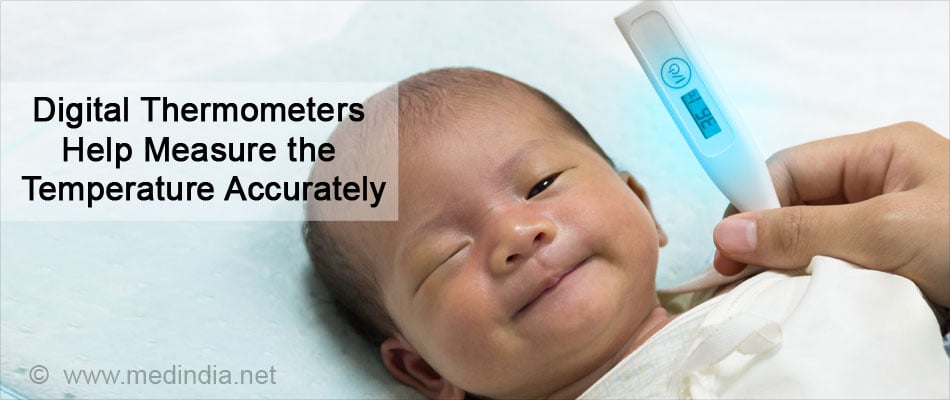
- Ear (tympanic) Thermometers� These devices tin can exist used to take a quick temperature reading from the ear, simply are expensive to buy. They tin also give wrong readings particularly if not placed properly into the ear canal, which is small in infants or if there is a build up of ear-wax. This thermometer is not suited for infants half-dozen months or younger.
- Temporal Artery Thermometers- These devices have an in-congenital infrared scanner that reads the temperature of the temporal artery on the brow.
Appropriate thermometer for dissimilar age groups:
- For babies younger than 3 months- Employ a digital thermometer to accept a rectal temperature. Temporal avenue thermometers may as well give authentic readings for kids in this age grouping.
- For babies between iii months and 6 months former- The best choice would be to utilise a digital thermometer to measure out rectal temperature.
- For kids between 6 months and 4 years old- Employ a digital thermometer to have a rectal temperature or axillary temperature, a temporal artery thermometer, or an electronic ear thermometer.
- For kids 4 years or older- Using a digital thermometer to accept the oral temperature is the near reliable means.
Modes of Taking Temperature
To take the rectal temperature:
The finish of the thermometer should be washed with soap and h2o and the tip of the thermometer should exist moistened with a lubricant, such every bit petroleum jelly.
In that location are ii positions in which the baby can exist placed:
- belly-down across on a house, flat surface
- or face-upwards with legs bent towards the chest
The lubricated end of the thermometer is inserted into the anal opening well-nigh � inch to ane inch, or until the tip of the thermometer is fully in the rectum.
Insertion should be stopped if resistance is felt. Wait until the thermometer beeps or sends other signals that the temperature is set to be read.
To accept the oral temperature:
Oral temperatures should not exist taken until 20 to thirty minutes subsequently the child finishes eating or drinking.
Place the tip of the thermometer under the tongue and ask your child to gently close his or her lips around information technology. The child must exist reminded not to seize with teeth down or talk, and to relax and breathe commonly through the nose.
Oral temperatures tin can be half a degree lower than the body temperature.
Wait until the thermometer beeps or sends other signals that the temperature is set up to be read.
To accept an axillary temperature:
This is a convenient way to take a child's temperature. Although not equally accurate equally a rectal or an oral temperature, some parents prefer to take an axillary temperature, peculiarly for kids who cannot concord a thermometer in their mouths.
Remove the child's shirt and undershirt, and place the thermometer under the armpit. Fold your child's arm beyond the chest to hold the thermometer in identify.
Expect until you hear the appropriate number of beeps or any other signal that indicates that the temperature is set up to be read.
What are the Symptoms and Signs of Baby Fever?
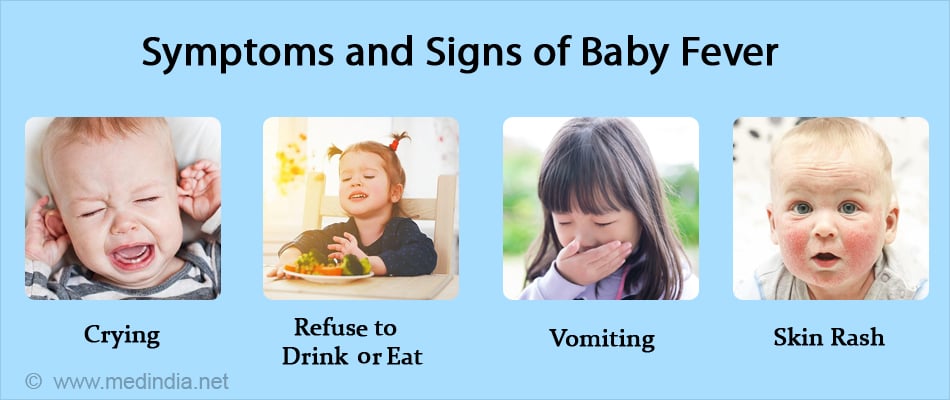
The baby's temperature should be taken if one of the post-obit is apparent:
- If the pare feels warmer than usual
- Increased irritability, fussiness and crying
- Increased sleepiness
- Crying in pain
- Refusing to drink and eat
- Refusing to breastfeed
- Suffering from diarrhea or vomiting
- Having animate difficulties
- Has a stiff cervix
- Swelling of the soft spot on an baby�s caput
- Not responding or less agile
- Skin rash
A fever acquired by any illness may contribute to aridity.
Temperature does not remain constant throughout the 24-hour interval. Sometimes the kid may sweat equally the temperature drops. If the kid or infant is not kept well-hydrated, they begin to prove signs of irritability.
Aridity tin can develop more quickly in children suffering from vomiting or diarrhea. Therefore, it is important to encourage the child to drink plenty of water if they have a fever.
Signs of dehydration include a dry mouth, no tears, sunken eyes, drowsiness and mostly becoming more unwell. Seek medical help if you doubtable that your kid is becoming dehydrated.
If temperatures rise too high, febrile convulsions may occur.
These are seizures that happen because of fever. They occur in nigh 4% of children between the ages of six months and five years.
Children outgrow febrile convulsions by the age of 4-v years. Though they are a cause for concern, febrile convulsions accept no long-term consequences.
How do you Diagnose Baby Fever?
The infant can be suspected of having a fever if:
- The peel on their forehead, back or stomach feels hotter than usual
- The cheeks are flushed
- The pare is excessively sweaty
- Shows signs of irritability or restlessness
- Does not eat / potable / breastfeed
The quickest and most effective style of confirming the diagnosis in babies is past using a digital thermometer. Thermometers requite fast and authentic readings.
How practice yous Treat Baby Fever?
Previously, doctors recommended treating infants or children on the ground of temperature alone. Just now, earlier prescribing medicines, the overall action and condition of the infant is judged.
If the babe is between 3 months of historic period and 3 years and has a low-course fever below 102�F (38.viii�C), it is advised to avoid medication. Merely if the infant is fussy and irritable, and temperature reads to a higher place 102�F (38.8�C), antipyretics like paracetamol or acetaminophen can exist considered.
For a baby younger than 3 months of age, a rectal temperature of 100.4�F (38�C) or higher, should exist treated as a sign of serious infection.
Despite fever, the illness may not be serious if the baby/child:
- is warning and active
- is interested in playing and engaging
- is eating / drinking / breastfeeding
- has a normal skin color
The child�s medico should be contacted if:
- The kid is under iii months and has a fever of 100.4�F (38�C) or college
- The child is between three to 6 months and has a temperature up to 102 F (38.9 C) and seems unusually irritable, lethargic or uncomfortable, or has a temperature college than 102 F (38.9 C)
- The kid is above 6 months up to 24 months and has a fever of 102 F (38.9 C) or college
- If the fever lasts for more than 5 days
- If the child has a delirious seizure
How practice yous Manage Fever in Babies?
Look out for signs of dehydration- Fever can contribute to dehydration. Dehydration can develop quickly if fever is accompanied by diarrhea and vomiting.
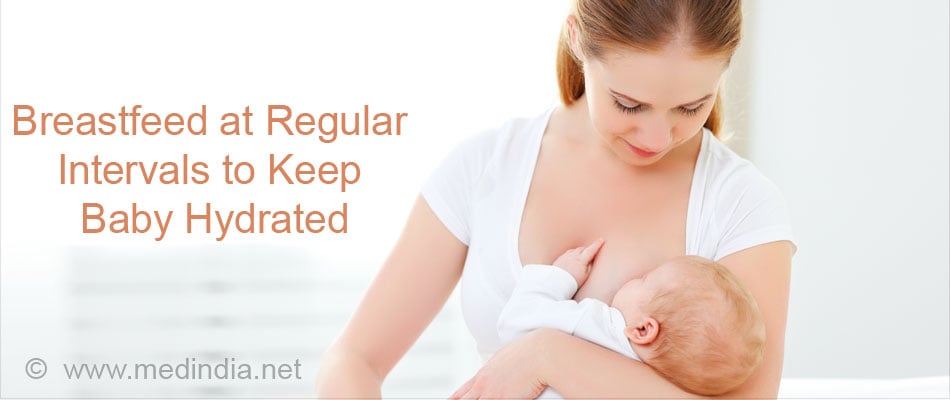
Infants should be breastfed at regular intervals and children should be encouraged to potable enough of fluids if they have a fever.
If fever is accompanied past vomiting and diarrhea, the doc might prescribe an electrolyte (rehydration) solution made especially for kids.
Exercise non strength feed-Fever in full general, reduces ambition. Let children to eat what they want to consume and practise not over-feed.
Adequate rest- Ensure that the child gets adequate residue.
Lukewarm bathroom- Lukewarm sponge bathroom helps in bringing down the temperature. Do not run common cold baths or water ice and alcohol rubs as it can worsen the situation.
No bundling upwards- Actress layer of clothing prevents the temperature from coming down. One layer of light clothing is advisable.
Comfy environment- The temperature in the room should neither be too hot or cold. It should be comfortable. Opening the window or a fan may help.
Health Tips
Plenty of fluids to drinkable: Keeping the torso hydrated will help the torso cool itself down.
Wet compresses: Using moisture compresses on the forehead, calves and wrists may help to bring the temperature down.
Low-cal dressing: Dressing in low-cal cotton clothes volition assistance the trunk heat to escape.
Residuum: Excessive moving around can raise the body temperature. Acceptable rest is advocated.
Source: https://www.medindia.net/patientinfo/baby-fever.htm
0 Response to "7 Month Old Baby Fever No Other Symptoms"
Post a Comment