what does it mean to blow smoke up your ass
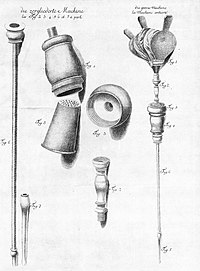
A 1776 textbook drawing of a tobacco smoke enema device, consisting of a nozzle, a fumigator and a bellows
The tobacco smoke enema, an insufflation of tobacco smoke into the rectum by enema, was a medical treatment employed by European physicians for a range of ailments.
Tobacco was recognised every bit a medicine soon later it was kickoff imported from the New World, and tobacco smoke was used by western medical practitioners equally a tool confronting common cold and drowsiness, but applying information technology past enema was a technique appropriated from the North American Indians. The procedure was used to treat gut pain, and attempts were oftentimes made to resuscitate victims of nearly drowning. Liquid tobacco enemas were ofttimes given to ease the symptoms of a hernia.
During the early 19th century the practice cruel into decline, when it was discovered that the main active amanuensis in tobacco smoke, nicotine, is poisonous.
Tobacco in medicine [edit]

A simpler, more portable device.
A: Pig'south bladder.
FG: Smoking pipage.
D: Mouthpiece to which the pipe is attached.
E: Tap.
K: Cone for rectal insertion.
Before the Columbian Exchange, tobacco was unknown in the Onetime Earth. The Native Americans, from whom the first western explorers learnt about tobacco, used the leaf for a variety of purposes, including religious worship, but Europeans soon became aware that the Americans also used tobacco for medicinal purposes. The French diplomat Jean Nicot used a tobacco poultice as an analgesic, and Nicolás Monardes advocated tobacco every bit a handling for a long listing of diseases, such as cancer, headaches, respiratory issues, breadbasket cramps, gout, intestinal worms and female diseases.[1] Contemporaneous medical science placed much weight on humorism, and for a short menses tobacco became a panacea. Its apply was mentioned in pharmacopoeia as a tool confronting cold and somnolence brought on by particular medical afflictions,[ii] its effectiveness being explained by its ability to soak upward moisture, to warm parts of the body, and to therefore maintain the equilibrium then important to a healthy person.[three] In an effort to discourage disease tobacco was also used to fumigate buildings.[4]
In addition to the Native Americans' use of tobacco fume enemas for stimulating respiration, European physicians also employed them for a range of ailments, due east.g., headaches, respiratory failure, colds, hernias, abdominal cramps, typhoid fever, and cholera outbreaks.[v]
An early on instance of European utilise of this procedure was described in 1686 by Thomas Sydenham, who to cure iliac passion prescribed outset bleeding, followed by a tobacco smoke enema:
Here, therefore, I conceive information technology about proper to drain first in the arm, and an hr or two afterwards to throw up a strong purging glyster; and I know of none and so strong and effectual as the smoke of tobacco, forced up through a large float into the bowels past an inverted pipage, which may be repeated after a curt interval, if the sometime, past giving a stool, does not open up a passage downwards.
—Thomas Sydenham[6]
However, emulating the Catawba, 19th-century Danish farmers reportedly used these enemas for constipated horses.[7]
Medical stance [edit]
To physicians of the time, the appropriate treatment for "credible expiry" was warmth and stimulation. Anne Greene, a woman sentenced to decease and hanged in 1650 for the supposed murder of her stillborn child, was plant by anatomists to be even so alive. They revived her by pouring hot cordial down her pharynx, rubbing her limbs and extremities, bleeding her, applying heating plasters and a "heating odoriferous Clyster to be cast up in her body, to give heat and warmth to her bowels." After placing her in a warm bed with another adult female, to keep her warm, she recovered fully and was pardoned.[eight]
Artificial respiration and the blowing of fume into the lungs or the rectum were thought to be interchangeably useful, simply the smoke enema was considered the virtually potent method, due to its supposed warming and stimulating properties.[ii] The Dutch experimented with methods of inflating the lungs, as a treatment for those who had fallen into their canals and manifestly drowned. Patients were besides given rectal infusions of tobacco smoke, as a respiratory stimulant.[9] Richard Mead was among the first Western scholars to recommend tobacco smoke enemas to resuscitate victims of drowning, when in 1745 he recommended tobacco glysters to treat iatrogenic drowning caused by immersion therapy[ clarification needed ]. His name was cited in one of the earliest documented cases of resuscitation by rectally applied tobacco smoke, from 1746, when a seemingly drowned woman was treated. On the advice of a passing sailor, the woman's husband inserted the stem of the crewman's pipage into her rectum, covered the bowl with a piece of perforated newspaper, and "blew hard". The adult female was apparently revived.[2]
In the 1780s the Royal Humane Society installed resuscitation kits, including smoke enemas, at various points along the River Thames,[ii] and by the turn of the 19th century, tobacco fume enemas had become an established practice in Western medicine, considered past Humane Societies to be every bit important as bogus respiration.[10]
"Tobacco glyster, jiff and drain.
Keep warm and rub till you succeed.
And spare no pains for what yous do;
May one day be repaid to you."—Houlston (24 September 1774)[11]
By 1805, the use of rectally applied tobacco smoke was then established as a way to care for obstinate constrictions of the gastrointestinal tract that doctors began experimenting with other delivery mechanisms.[12] In one experiment, a decoction of one-half a drachm of tobacco in iv ounces of water was used every bit an enema in a patient suffering from general convulsion where there was no expected recovery.[12] The decoction worked every bit a powerful agent to penetrate and "roused the sensibility" of the patient to end the convulsions, although the decoction resulted in excited sickness, vomiting, and profuse perspiration.[12] Such enemas were often used to treat hernias. A middle-anile man was reported in 1843 to have died following an application, performed to treat a strangulated hernia,[13] and in a similar instance in 1847 a woman was given a liquid tobacco enema, supplemented with a chicken broth enema, and pills of opium and calomel (taken orally). The woman later recovered.[xiv]
In 1811, a medical writer noted that "[t]he powers of the Tobacco Enema are and then remarkable, that they have arrested the attention of practitioners in a remarkable mode. Of the effects and the method of exhibiting the smoke of Tobacco per anum, much has been written", providing a list of European publications on the subject.[fifteen] Smoke enemas were also used to treat various other afflictions. An 1827 report in a medical journal tells of a woman treated for constipation with repeated smoke enemas, with piddling apparent success.[sixteen] According to a written report of 1835, tobacco enemas were used successfully to treat cholera "in the phase of collapse".[17]
I may observe, that before I was called to this case, stercoraceous vomiting had decidedly set in. My object in ordering the tobacco infusion and fume enemata was to favour the reduction of any obscure hernia or muscular spasm of the bowel which might exist. I besides directed that the attendants of the daughter should, after she had taken the crude mercury, frequently enhance her upwards in bed, (she was likewise feeble to raise herself,) to alter her position from one side to the other, from the back to the belly, and vice versa, with the view of favouring the gravitation of the mercury to the lower bowels.
—Robert Dick, M.D. (1847)[18]
Pass up [edit]
Attacks on the theories surrounding the ability of tobacco to cure diseases had begun early in the 17th century. King James I was scathing of its effectiveness, writing "[it] volition not deigne to cure heere whatever other than cleanly and gentlemanly diseases." Others claimed that smoking stale out the humours, that snuff made the brain sooty, and that former people should not smoke as they were naturally dried up anyhow.[xix]
While certain beliefs regarding the effectiveness of tobacco fume to protect confronting disease persisted until well into the 20th century,[twenty] the utilise of fume enemas in Western medicine declined after 1811, when through fauna experimentation Benjamin Brodie demonstrated that nicotine—the principal active agent in tobacco smoke—is a cardiac poisonous substance that can stop the circulation of claret.[10]
See likewise [edit]
- Enema
- History of tobacco
References [edit]
- ^ Kell 1965, pp. 99–102
- ^ a b c d Lawrence 2002, p. 1442
- ^ Kell 1965, p. 103
- ^ Meiklejohn 1959, p. 68
- ^ Sterling Haynes, Medico (December 2012). "Special feature: Tobacco smoke enemas". British Columbia Medical Journal. Doctors of BC. Retrieved 2019-03-29 .
- ^ Sydenham 1809, p. 383
- ^ Kell 1965, p. 109
- ^ Hughes 1982, p. 1783
- ^ Price 1962, p. 67
- ^ a b Hurt et al. 1996, p. 120
- ^ Lowndes 1883, p. 1142
- ^ a b c Currie 1805, p. 164
- ^ Japiot 1844, p. 324
- ^ Long 1847, p. 320
- ^ Anon2 1811, p. 226
- ^ Jones 1827, p. 488
- ^ Anon1 1835, p. 485
- ^ Dick 1847, p. 276
- ^ Kell 1965, p. 104
- ^ Kell 1965, p. 106
Bibliography
- Anon1 (1835), "Accounts of several cases of Cholera, treated by Tobacco Enema, extracted from the Proceedings of the Lodge", Transactions of the Medical and Concrete Society of Calcutta, 7
- Anon2 (1811), "Remarks on the History and Use of Tobacco", The Medical and Physical Periodical, vol. 25
- Currie, James (1805), Medical Reports, on the Furnishings of Water, Cold and Warm: As a Remedy in Fever and Other Diseases, Whether Applied to the Surface of the Trunk, Or Used Internally, vol. 1, London: T. Cadell and W. Davies
- Dick, Robert (1847), Thomas Wakley, Surgeon (ed.), "The Treatment of Dyspepsia", The Lancet, 49 (1228): 275–276, doi:10.1016/S0140-6736(02)86623-5
- Hurt, Raymond; Barry, J. East.; Adams, A. P.; Fleming, P. R. (1996), The History of Cardiothoracic Surgery from Early on Times, Informa Health Care, ISBN978-1850706816
- Hughes, Trevor J. (1982), "Miraculous Deliverance Of Anne Green: An Oxford Case Of Resuscitation In The Seventeenth Century", British Medical Journal, 285 (6357): 1792–1793, doi:10.1136/bmj.285.6357.1792, JSTOR 29509089, PMC1500297, PMID 6816370
- Japiot, K. (1844), "Death Occasioned by the Administration of a Tobacco Enema", Provincial Medical Journal and Retrospect of the Medical Sciences, 7 (174): 324, JSTOR 25492616
- Jones, John (1827), "Constipation of the Bowels during twenty-one days, successfully treated.", The London Medical and Concrete Journal, 58
- Kell, Katharine T. (1965), "Tobacco in Folk Cures in Western Society", The Journal of American Folklore, 78 (308): 99–114, doi:10.2307/538277, JSTOR 538277
- Lawrence, Ghislaine (20 April 2002), "Tools of the Trade, Tobacco smoke enemas", The Lancet, 359 (9315): 1442, doi:10.1016/S0140-6736(02)08339-iii, S2CID 54371569, retrieved 2008-11-27
- Long, Dr Richard (1847), "Opium in Strangulated Hernia", Provincial Medical & Surgical Periodical, BMJ, vol. 11, no. 12, p. 320, JSTOR 25499878
- Lowndes, Frederick Walter (1883), "Fifty-First Annual Meeting Of The British Medical Association", The British Medical Periodical, i (1171): 1141–1152, doi:ten.1136/bmj.one.1171.1141, JSTOR 25263327, S2CID 220003471
- Meiklejohn, A. (1959), "Outbreak of Fever in Cotton Mills at Radcliffe, 1784", British Periodical of Industrial Medicine, 16 (1): 68–69, doi:ten.1136/oem.16.i.68, PMC1037863
- Nordenskiold, Erland (1929), "The American Indian as an Inventor", Journal of the Imperial Anthropological Establish, 59: 273–309, doi:10.2307/2843888, JSTOR 2843888
- Price, J. L. (1962), "The Evolution of Breathing Machines", Medical History, half dozen (i): 67–72, doi:10.1017/s0025727300026867, PMC1034674, PMID 14488739
- Sydenham, Thomas (1809), "Schedula Monitoria, or an Essay on the Rise of a New Fever", in Benjamin Rush (ed.), The works of Thomas Sydenham, M.D., on acute and chronic diseases: with their histories and modes of cure, Philadelphia: B. & T. Kite
Source: https://en.wikipedia.org/wiki/Tobacco_smoke_enema
0 Response to "what does it mean to blow smoke up your ass"
Post a Comment